Category: Law

  • Lexster Law LLP Honoured at the ALB India Law Awards 2026

    Lexster Law LLP Honoured at the ALB India Law Awards 2026

    Lexster Law LLP is honoured to have been recognised at the ALB India Law Awards 2026, receiving the prestigious Dispute Resolution Boutique Law Firm of the Year 2026 award. The Firm was also recognised as an ALB India Firm to Watch 2026, reflecting its growing presence and contribution to India’s evolving legal landscape.

    The ALB India Law Awards celebrate excellence, innovation, and outstanding achievements within the legal profession. These recognitions reaffirm Lexster’s unwavering commitment to delivering strategic, client-centric dispute resolution services while upholding the highest standards of professionalism, integrity, and legal excellence.

    This milestone would not have been possible without the continued trust and confidence of our clients, the encouragement of our colleagues and peers, and the invaluable support of our dedicated team and Of Counsels. Their commitment, expertise, and collaborative spirit have been instrumental in this achievement.

    As we celebrate this recognition, we remain steadfast in our commitment to delivering exceptional legal solutions, fostering meaningful client relationships, and continuing to contribute to the advancement of dispute resolution in India.

  • Dubai Arbitration Week 2025: Lexster Law hosts Panel discussion on Navigating Multiparty and Cross-Border Disputes in Mega Project Arbitration.
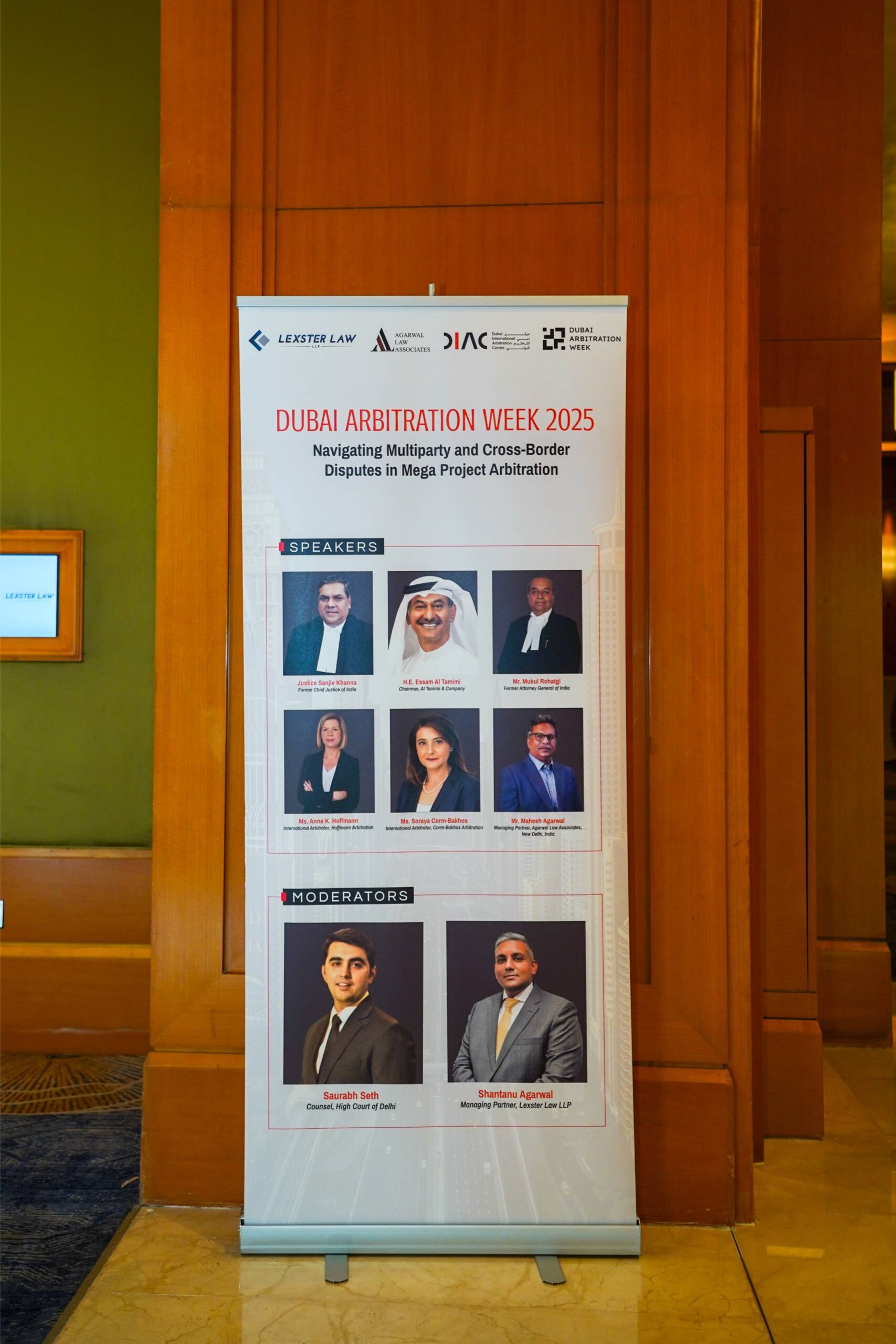
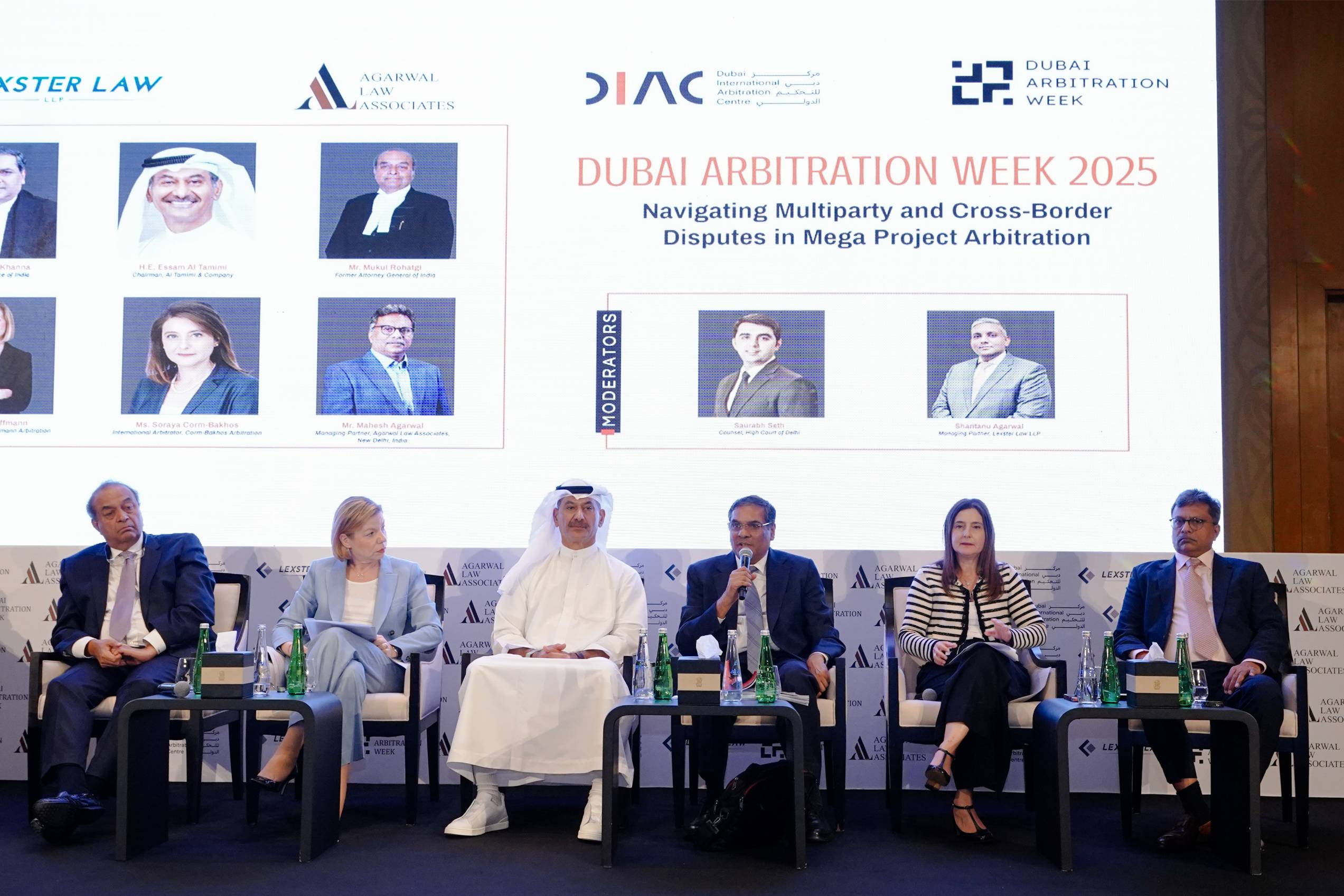
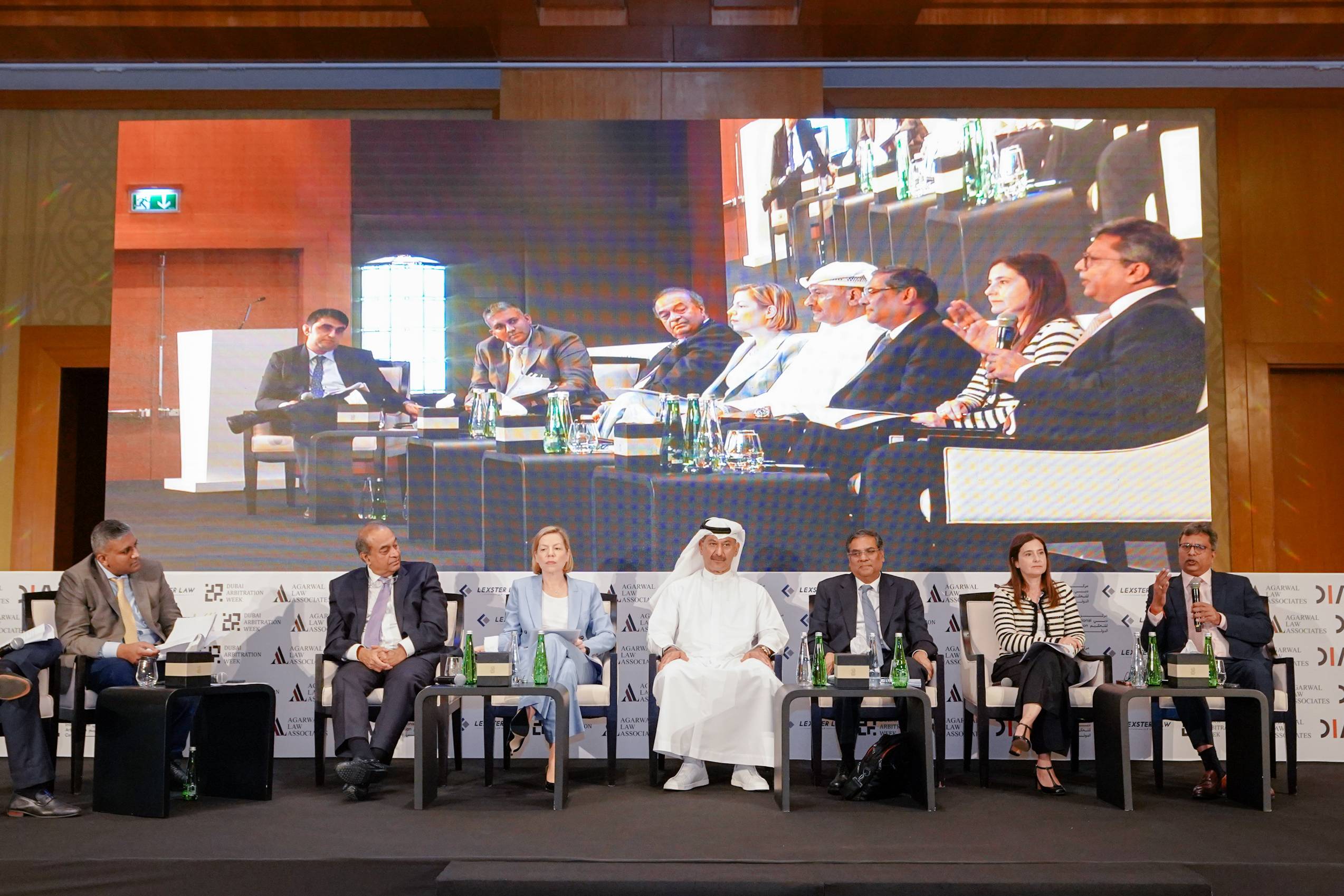
    Dubai Arbitration Week 2025: Lexster Law hosts Panel discussion on Navigating Multiparty and Cross-Border Disputes in Mega Project Arbitration.
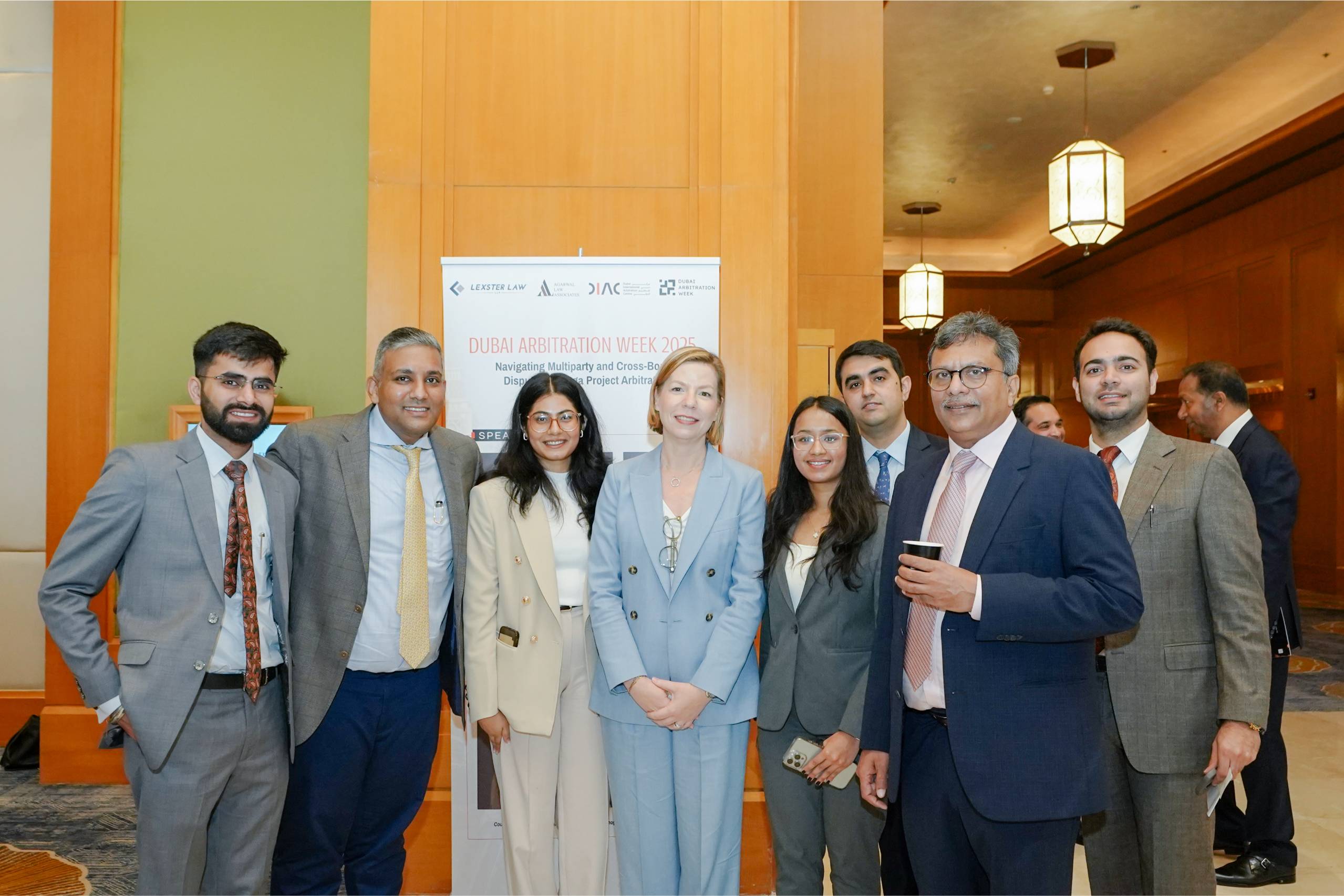
    Lexster Law had the honour of being a Gold Sponsor at the Dubai Arbitration Week 2025 organised by Dubai International Arbitration Centre (DIAC), one of the most prestigious global convening in the world of arbitration.


    One of the proudest moments came when we co-hosted a panel discussion on Navigating Multiparty and Cross-Border Disputes in Mega Project Arbitration. We had a stellar panel of speakers, including: Justice Sanjeev Khanna (Former Chief Justice, Supreme Court of India), Mr. Essam Al Tamimi (Chairman at Al Tamimi & Company), Mr. Mukul Rohatgi (Former Attorney General of India), Ms. Anne K. Hoffmann (International Arbitrator), Ms. Soraya Corm-Bakhos, (FCIArb,International Arbitrator), Mr. Mahesh Agarwal.

  • India ADR Week 2025: Exploring the Group of Companies Doctrine and Non-Signatories in Arbitration

    India ADR Week 2025: Exploring the Group of Companies Doctrine and Non-Signatories in Arbitration

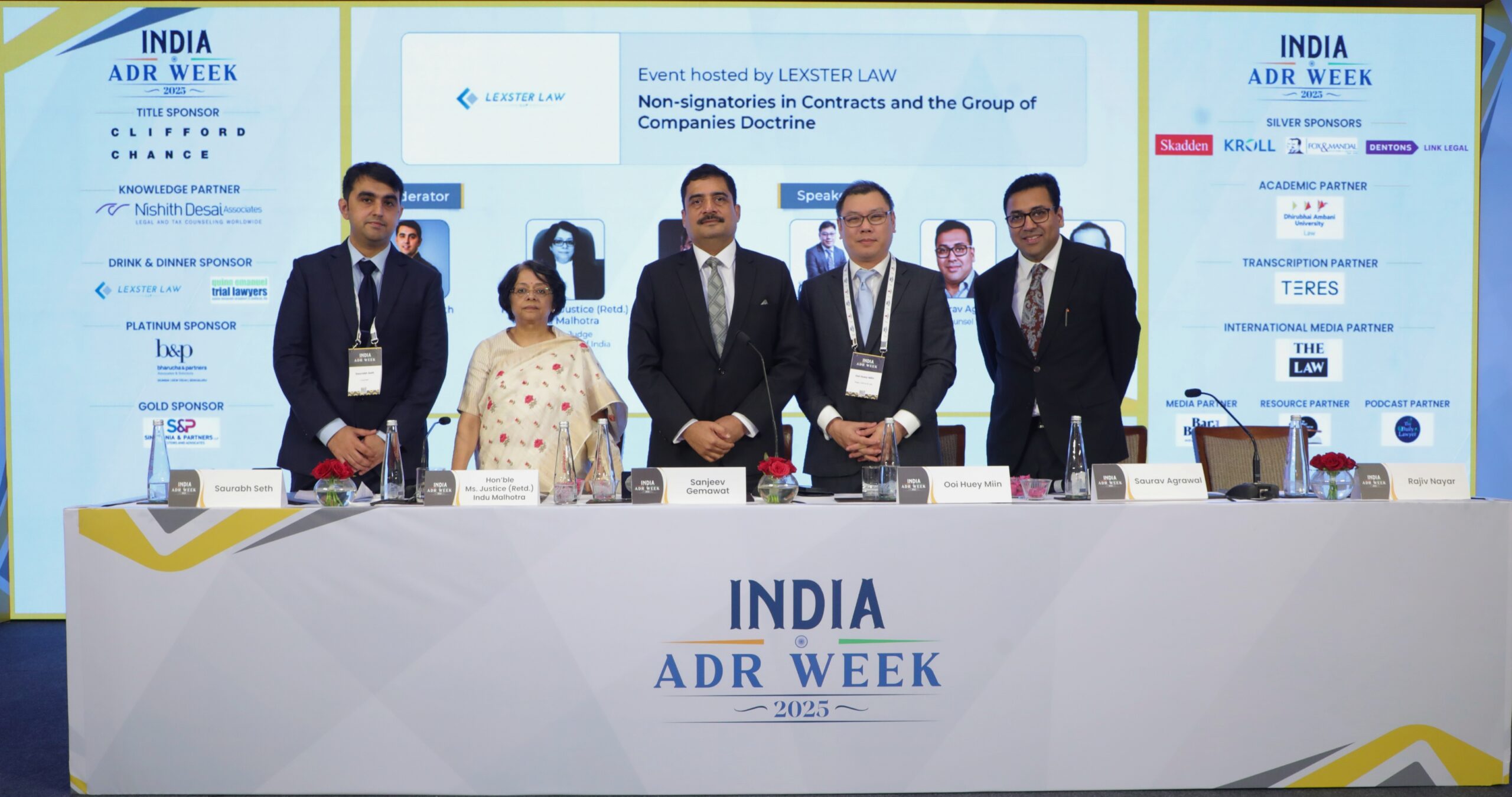
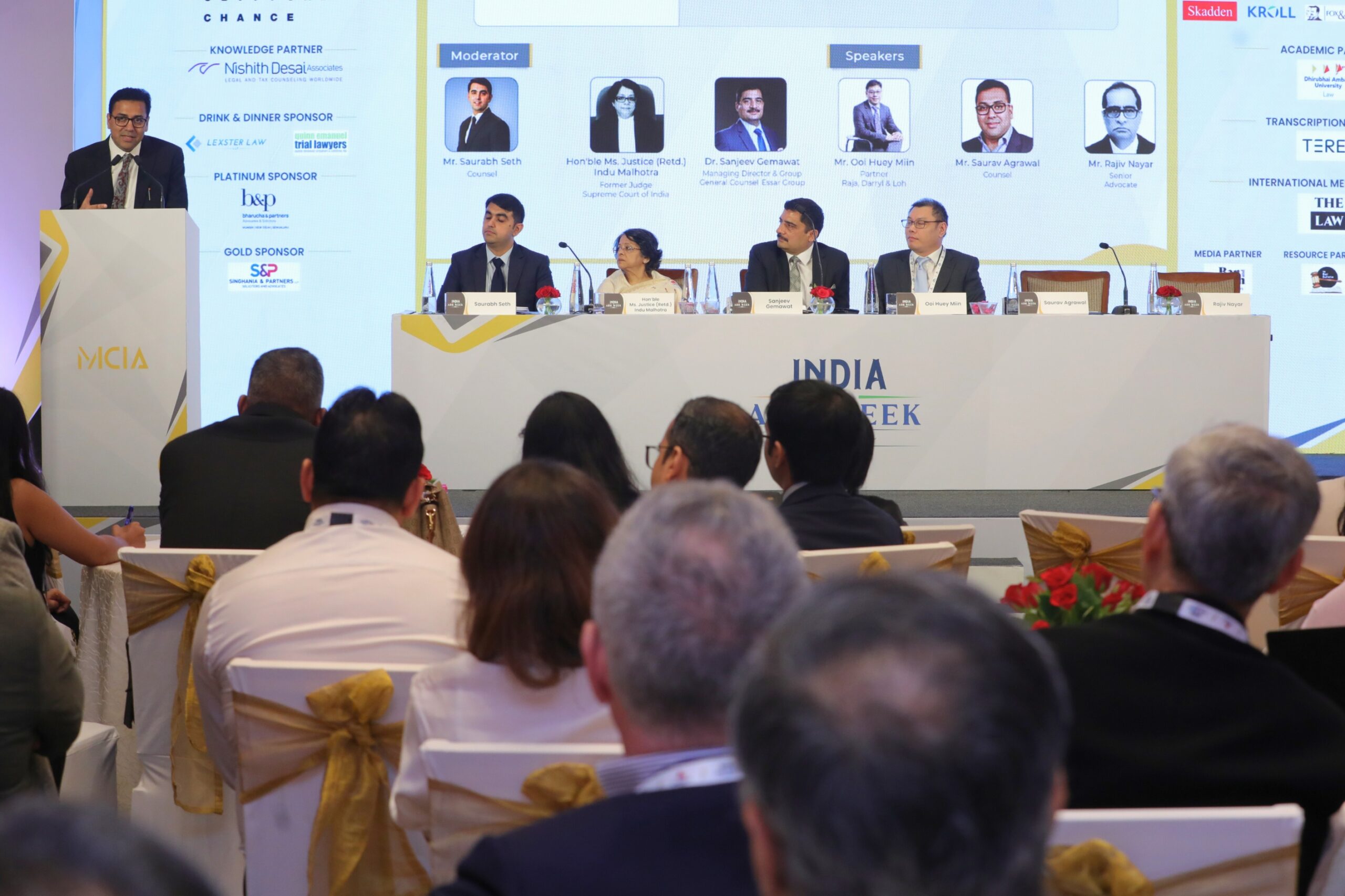
    We hosted a panel discussion during India ADR Week 2025 on 18 September 2025 on “Non-Signatories in Contracts and the Group of Companies Doctrine”, featuring Hon’ble Ms. Justice Indu Malhotra (Former Judge, Supreme Court of India), Dr. Sanjeev Gemawat (Managing Director & Group General Counsel, Essar Group), Mr. Ooi Huey Miin (Partner, Rajah Darryl & Loh, Malaysia), and Mr. Saurav Agrawal (Counsel, New Delhi). The session was moderated by Mr Saurabh Seth, Counsel, New Delhi.

  • The Intersection of Copyright Law and Artistic Creativity: Lessons  from Andy Warhol Foundation v. Goldsmith and a Comparison with  Indian Copyright Law

    The Intersection of Copyright Law and Artistic Creativity: Lessons  from Andy Warhol Foundation v. Goldsmith and a Comparison with  Indian Copyright Law

    Introduction

    The Andy Warhol Foundation for the Visual Arts v. Goldsmith case has sparked extensive  discussions on the relationship between copyright law and artistic expression. This memo briefly  explores the case and compares the fair use provisions in U.S. copyright law with those in Indian  copyright law. By examining these frameworks, we can gain valuable insights into the challenges  of balancing copyright protection and artistic innovation.

    Andy Warhol Foundation for the Visual Arts v. Goldsmith

    In this recent landmark case, the Supreme Court of the United States (SCOTUS) ruled in favour  of celebrity photographer Lynn Goldsmith, affirming her claim that the Andy Warhol estate  infringed her copyright. In 1981, Goldsmith photographed the renowned musician, Prince, for  Rolling Stone magazine. In 1984, Andy Warhol created a series of silkscreen prints based on  Goldsmith’s photograph. The Andy Warhol Foundation later licensed one of Warhol’s prints to  Condé Nast for use in a magazine article about Prince.  

    Goldsmith sued the Andy Warhol Foundation for copyright infringement. The district court  granted summary judgment to the foundation, finding that its use of Goldsmith’s photograph  was fair use. However, the Second Circuit reversed the ruling, holding that the foundation’s use  was not transformative and, therefore, not fair use.  

    The SCOTUS affirmed the Second Circuit’s decision. It held that the foundation’s use of  Goldsmith’s photograph was not transformative because it did not add a new expression or  meaning to the original work. The court also found that the foundation’s use was commercial in  nature, which weighed against a finding of fair use.  

    The SCOTUS’s verdict sheds light on the complex considerations involved in determining fair use,  with Justice Sonia Sotomayor authoring the majority opinion. 

    The Fair Use Factors: A Comparative Analysis  

    In the United States, fair use is determined by four key factors: the purpose and character of  the use, the nature of the copyrighted work, the amount used, and the effect on the market for  

    1 Read the full opinion of the SCOTUS at 21-869 Andy Warhol Foundation for Visual Arts, Inc. v. …  Supreme Court of the United States (.gov) https://www.supremecourt.gov › opinions (google.com)

    www.lexsterlaw.com 1  

    the original work. Similarly, Indian copyright law includes a fair use defense, considering factors  such as the purpose and character of the use, the nature of the copyrighted work, the proportion  used, and the impact on the potential market for the copyrighted work.  

    In Andy Warhol Foundation for the Visual Arts v. Goldsmith, factors such as the commercial nature  of the use, the absence of transformative elements, and the potential negative impact on the  market for Goldsmith’s photograph were decisive in the SCOTUS’s decision. Applying a similar  analytical framework, Indian courts would likely reach a similar conclusion, considering the  broad application of fair use principles within Indian copyright law. However, it is important to  note that the Indian courts have not yet ruled on a case directly analogous to Andy Warhol  Foundation v. Goldsmith. As such, it is impossible to say with certainty how the Indian courts would  rule in a similar case.  

    While Indian and U.S. laws on fair use are similar, some key differences exist. Indian law does  not explicitly mention the transformative nature of a work or the commercial nature of use as  factors in determining fair use, but Indian courts have held that these factors are relevant. It is  vital to be aware of the specific provisions of Indian copyright law when creating and using  copyrighted material in India.  

    Conclusion  

    The Andy Warhol Foundation v. Goldsmith case offers valuable insights into fair use in U.S.  copyright law and prompts a consideration of the potential application of similar principles  within Indian copyright law. Still, balancing copyright protection and artistic innovation remains  a complex challenge in both legal frameworks.

    www.lexsterlaw.com 2 

  • CERT‐In Rules and Directions 

    CERT‐In Rules and Directions 

    With an increasing number of Indians using the Internet and cyberspace and  the goal of a $1 trillion digital economy by 2026, the Government of India is taking  steps to strengthen cybersecurity in India. It has established an evolving framework  comprising statutes, rules, directions and supervisory agencies intended to keep  cyberspace safe for individuals and businesses.  

    CERT‐In

    The Indian Computer Emergency Response Team (“CERT‐In”) is a national  organisation appointed1 by the Government of India to ensure cyber safety in India.  

    Functions of CERT‐In. The functions of the CERT-In are2:  

    • a) collection, analysis, and dissemination of information on cyber incidents; 
      b) forecast and alerts of cyber security incidents;
    • c) determining emergency measures for handling cyber security incidents;
    • d) coordination of cyber incidents response activities;  
    • e) issuing guidelines, advisories, vulnerability notes and white papers  relating to information security practices, procedures, prevention,  response, and reporting of cyber incidents; and  
    • f) such other functions relating to cyber security as may be prescribed.  

    1 The appointment was made vide notification dated 27 October 2009 in terms of section 70B of the  Information Technology Act, 2000 (“IT Act”)

    2 Section 70B(4) of the Information Technology Act, 2000 

    The CERT-In Rules3 prescribe how CERT-In performs its functions and  provide for the level of support provided by CERT-In concerning different types of  ‘cyber security incidents.’4 

    Powers of CERT‐In. CERT-In is the referral agency for cyber users in India for  responding to cyber security incidents.5 CERT-In is empowered to seek information  from and issue directions to service providers, intermediaries, data centres, body  corporate, and other persons to carry out its functions.6 Information regarding logs  may be requisitioned by an officer of CERT-In, not below the rank of Deputy Secretary  to the Government of India. The CERT-In Rules also set out the procedure to be  followed if such information is not provided. Persons that fail to provide the  information called for or follow directions issued by the CERT-In may be punished  with imprisonment, a fine or both7.  

    Cyber Security Directions 8

    The Cyber Security Directions provide a framework for ensuring cyber security in India. They were issued pursuant to consultations with industry and government organisations and other stakeholders.  

    3 Information Technology (The Indian Computer Emergency Response Team and Manner Performing  Functions and Duties) Rules, 2013 published vide notification dated 16 January 2014 pursuant to  section 70B(5) of the IT Act read with section 87(zf) of the IT Act 

    4 Rule 11 of the CERT-In Rules  

    5 Rule 8 of the CERT-In Rules  

    6 Rule 14 of the CERT-In Rules  

    7 Section 70B(7) of the IT Act  

    8 Directions dated 28 April 2022 issued by the Ministry of Electronics and Information Technology,  CERT-In under section 70B(6) of the Information Technology Act, 2000 relating to information  security practices, procedure, prevention, response and reporting of cyber incidents for Safe & Trusted  Internet, No. 20 (3)/2022-CERT-In 

    Person Covered by Cyber Security Directions. Service providers,  ‘intermediaries’9, data centres, body corporate, Virtual Private Server (VPS)  providers, cloud service providers, Virtual Private Network (VPN) Service providers,  virtual asset service providers, virtual asset exchange providers, custodian wallet providers and government organisations (“Parties Covered by CERT‐In Directions”) are required to comply with the Cyber Security Directions.  

    Duty to Report. Parties Covered by CERT-In Directions are required to immediately report10 cyber security incidents to the CERT-In. The methods and formats of reporting cyber security incidents are published on CERT-In’s website.  

    Duty to Synchronise. Parties Covered by CERT-In Directions are required to connect to the Network Time Protocol (NTP) Server of the National Informatics  Centre (NIC) or National Physical Laboratory (NPL) or with NTP servers traceable to these NTP servers, for synchronisation of all their ICT systems clocks. This means that the clocks in the network of the service providers, intermediaries, data centres, body corporate and governmental organizations must be in sync with the NTP server and will provide the exact same time as NTP. This, in turn, will help in determining the  exact time when a cyber security incident took place.  

    Duty to Maintain Logs. Cyber Securities Directions also mandate that Parties  Covered by CERT-In Directions maintain logs of all their ICT systems and maintain  them securely for a rolling period of 180 days. The said logs are to be maintained  within the jurisdiction of India and must be provided to the CERT-In while reporting  an cyber security incident or when so directed or sought by the CERT-In.  

    9 Defined in section 2(w) of the IT Act.  

    10 Rule 12 of the CERT-In Rules 

    Duty to Know Customer. Data centres, VPS providers, Cloud Service providers and VPN service providers are required to maintain accurate information about subscribers/customers and the hiring services availed by subscribers etc. for a period  of five years or such longer duration according to law after cancellation or withdrawal of the registration.  

    Overall, the Cyber Security Directions are intended to improve India’s overall cyber security framework so that the Internet is safe for its citizens.  

    Things to Think About

    Issues related to the CERT-In Rules or the Cuber Security Directions that  require deeper thinking include:  

    • How do the CERT-In Rules or the Cuber Security Directions affect the  individual right to privacy?  
    • Are confidentiality agreements affected by CERT-In Rules or the Cuber  Security Directions?  
    • Do the CERT-In Rules or the Cuber Security Directions cover non Indian entities?  
    • How is the confidentiality of customer data that may be reported to  CERT-In ensured? How should data that is required to be disclosed to CERT In that belongs to data subjects covered by data protection regimes such as  GDPR be handled?  ∙ Where should the logs that may be requisitioned by the CERT-In be  stored?
  • EU Shows the Way to Responsible Regulation of AI  

    EU Shows the Way to Responsible Regulation of AI  

    European Union’s AI Act – The Dawn of a New Regulatory Regime

    The European Union’s Artificial Intelligence Act (AI Act) stands as a pivotal milestone in the European  Union’s pursuit of effective artificial intelligence (AI) governance. This groundbreaking proposal strives  to establish a comprehensive regulatory framework that harmonizes the development, market  deployment, and responsible usage of AI systems throughout the EU. It is the first comprehensive  regulatory framework for AI systems in the world. The AI Act is expected to significantly affect the  governance of AI systems in the EU. It is also expected to have a broader impact as other jurisdictions  worldwide consider the AI Act a model for their own AI regulations.  

    AI Regulation In India – A Good Start Is Half The Battle

    The Indian government has not yet announced plans to introduce a specific law to regulate AI. However,  the government has taken a few steps to promote the responsible development and use of AI. For  example, in 2020, the government published a national strategy for AI that sets out principles for the  responsible development and use of AI. The government has also established several working groups to  study AI’s potential risks and benefits and develop recommendations for mitigating the risks.  

    The Indian government might introduce a specific law to regulate AI. However, the government also might  continue to take a more informal approach to regulating AI by issuing guidelines and best practices. 

    Overview of the AI Act

    The primary objective of the AI Act is to safeguard the development and utilization of AI systems in a  manner that prioritizes safety, reliability, and responsibility while simultaneously upholding fundamental  rights and freedoms.  

    The AI Act classifies AI systems into three distinct risk categories. AI systems categorized as presenting  an unacceptable level of risk, such as those employed for social scoring, mass surveillance, or biometric  identification without consent, are prohibited. High-risk AI systems, which encompass those utilized in  automated decision-making, critical infrastructure, or law enforcement, are subject to specific  requirements, including mandatory conformity assessment and market surveillance. Conversely, low or  negligible risk AI systems are not subjected to any particular requirements.  

    In addition to the risk-based classification, the AI Act sets forth general requirements that are applicable  to all AI systems, regardless of their risk category. These requirements encompass transparency,  accountability, robustness, and privacy. AI systems must be designed to ensure transparency and  comprehensibility, providing users with information concerning their functionality, training, and decision 

    making processes. Furthermore, provisions must be in place to ensure accountability, allowing for human  intervention when deemed necessary. It is imperative that AI systems are designed in a manner that  guarantees robustness, resilience against manipulation, bias, and errors. Additionally, AI systems must  uphold privacy standards and comply with the General Data Protection Regulation (GDPR) when  handling personal data.  

    The AI Act is still under negotiation, but it is expected to be adopted by the European Parliament and  the Council of the European Union in 2023. Once adopted, the AI Act will directly apply to all EU Member  States. 

    Key Takeaways

    1. The AI Act demonstrates the EU’s commitment to responsible regulation of AI, setting a pioneering example for the global community. The AI Act has garnered acclaim from experts who commend its ambitious and comprehensive nature.  
    2. Clear regulations and guidelines are necessary to ensure the safe, responsible, and ethical development and utilization of AI. The AI Act serves as a foundation in this regard, facilitating the promotion of responsible AI practices. Nevertheless, some experts have expressed that the  AI Act could be more extensive. Specifically, they propose the inclusion of more explicit mandates pertaining to AI systems implemented in sensitive domains like law enforcement and healthcare.  
    3. The AI Act could serve as a compelling model that can be emulated by other countries seeking to advance their own frameworks for AI regulation and governance. 
  • Supreme Court Rules That Intent Is Relevant In Insider Trading Cases   

    Supreme Court Rules That Intent Is Relevant In Insider Trading Cases   

    In Securities and Exchange Board of India v. Abhijit Rajan1, the Supreme Court held  that the insider’s intent must be considered before determining whether the insider is  guilty of insider trading. If the insider did not intend to take advantage of the unpublished  price sensitive information (“UPSI”), the person could not be guilty of insider trading.  

    The Supreme Court summarised the applicable tests for determining whether a  person is guilty of insider trading as follows:  

    • (i) Is the person an ‘insider’ under Regulation 2(e) of the Securities And  Exchange Board of India (Prohibition Of Insider Trading) Regulations,  1992 (“Regulations”)
    • (ii) Is the information “price sensitive information”2?  
    • (iii) Is the information ‘unpublished’3
    • (iv) Has the person indulged in trading of securities of the company4?  

    The court held that each of the tests was passed in the present case, viz., the respondent  was an insider of a company who possessed UPSI and indulged in trading of the securities  of the said company before the publication of the UPSI. However, for reasons set out  below, it held that this was insufficient to hold the respondent guilty of insider trading.  

    SEBI argued inter alia that the Regulations set out a strict prohibition of insider  trading5, which cannot be avoided on any grounds, including the materiality of impact or  intent of the insider. On the other hand, the respondent argued that whether the  information is price sensitive depends on the materiality of impact on price. The  respondent also argued that the purpose of trading and intent for the trading, along with  other relevant circumstances, must be considered before determining whether the  insider is guilty of insider trading. 

    Judgment dated September 19, 2022, by Hon’ble Justices Indira Banerjee and V Ramasubramanian in Civil  Appeal No. 563 of 2020  

    Regulation 2(ha) of the Regulations 

    Regulation 2(k) of the Regulations 

    Regulations 3 and 4 of the Regulations 

    Regulations 3 and 4 of the Regulations 

    The court appears to have found the respondent’s arguments more persuasive. It  held that it is necessary to see whether the information will affect the security’s price materially. It also held that the activities of the insider must be examined and reasoned  that if the trading is not driven by a motive for profit, the person cannot be guilty of  insider trading. Specifically, it stated: 

    If a person enters into a transaction which is surely likely to result in loss, he cannot be accused of insider trading. In other words, the actual gain or loss is immaterial, but the motive for making a gain is essential.

    The court determined on the facts of the case that the respondent’s actions were  not motivated by the pursuit of underserving gains. It found in this case that because the  UPSI was likely to increase the market price of the company’s securities on disclosure,  the respondent’s sale of securities before disclosure did not amount to insider trading. 

    Sharad Kumar

    Surabhi Katyal

  • Supreme Court’s Stamping Decision: Blow to the Validity of Arbitration Agreements?  

    Supreme Court’s Stamping Decision: Blow to the Validity of Arbitration Agreements?  

    The Supreme Court’s recent landmark judgment by a 3-2 majority1 in N. N. Global Mercantile Pvt. Ltd. v. Indo Unique Flame Ltd.2, held that an arbitration agreement in an unstamped contract is not enforceable under Indian law if such contract is not duly stamped. The court thus overruled its previous decision by a  bench of three judges3

    Background Facts 

    The case involves a sub-contract between the first respondent and the appellant, which included an arbitration agreement in a Work Order. The appellant had provided a bank guarantee, and after its invocation, the appellant filed a suit against the encashment of the bank guarantee. The first respondent sought reference under Section 8 of the Arbitration and Conciliation Act, 1996, and filed a Writ Petition after the commercial court rejected their application. One contention raised was that the arbitration agreement was unenforceable due to the unstamped Work Order.  However, the High Court allowed the Writ Petition. The issue before the Supreme  Court was whether the arbitration agreement was enforceable despite the Work Order being unstamped and therefore unenforceable under the Stamp Act, 1899.  

    The bench of three judges, in N. N. Global Mercantile Pvt. Ltd. v. Indo Unique Flame Ltd.4 unanimously agreed with the appellant and held that the arbitration agreement in the Work Order was valid and enforceable, even though the Work Order was unstamped, as per the doctrine of separability of the arbitration agreement from the main contract. Accordingly, it overruled its previous judgments in SMS Tea Estates5 and Garware Wall Ropes6, wherein it was held that an unstamped contract’s arbitration agreement is non-existent in law and cannot be acted on. The Supreme  Court also agreed with the appellant and held that the arbitrator could decide the stamp duty payable on the Work Order. It also observed that the court’s role under  Section 11 of the Arbitration Act, 1996 was limited to examining the existence of an arbitration agreement and not its validity or enforceability.  

    However, since a coordinate bench in Vidya Drolia v. Durga Trading Corporation7 affirmed the judgment in Garware Wall Ropes, the bench of three judges  considered it necessary that the issue of the validity of an arbitration agreement in an  

    1 K. M. Joseph, Aniruddha Bose and C. T Ravikumar, JJ., comprising the majority. 

    2 (2021) 4 SCC 379  

    3 Dr. D. Y. Chandrachud, Indu Malhotra and Indira Banerjee, JJ.  

    4 (2021) 4 SCC 379  

    5 (2011) 14 SCC 66  

    6 (2019) 9 SCC 209  

    7 (2021) 2 SCC 1 

    unstamped contract be authoritatively settled by a constitution bench of the Supreme  Court. Hence, N. N. Global Mercantile Pvt. Ltd. v. Indo Unique Flame Ltd. was referred to a five-judge constitution bench.  

    Contentions Before the Bench of Five Judges

    The appellant, N.N. Global Mercantile Pvt. Ltd., contended that the arbitration  agreement in the Work Order was valid and enforceable, as per the doctrine of  separability of the arbitration agreement from the main contract, even though the  work order was unstamped. It also argued that the stamp duty payable on the Work  Order could be decided by the arbitrator, who had the power to impound the  document and direct the parties to pay the stamp duty and penalty. It further argued  that fraud or fraudulent invocation of a bank guarantee was arbitrable unless it  affected the public interest or public policy of India.  

    The respondents, Indo Unique Flame Ltd. and others, contended that the  arbitration agreement in the Work Order was invalid and unenforceable, as the Work  Order was unstamped and not a valid contract under Section 2(h) of the Contract Act,  1872. They also argued that stamp duty payable on the Work Order had to be decided by a court, acting under Section 11 of the Arbitration and Conciliation Act, 1996, as per the judgments in SMS Tea Estates and Garware Wall Ropes. They further argued that fraud or fraudulent invocation of a bank guarantee was not arbitrable, as it involved severe allegations of criminality and malpractice. 

    Decision and Key Takeaways Regarding Stamping of Arbitration Agreements

    1. An unstamped instrument containing an arbitration clause cannot be  considered a contract enforceable under Section 2(h) or Section 2(g) of the  Contract Act, 1872. An arbitration agreement that is part of an unstamped  contract cannot be acted on or enforced by a court unless the parties cure the  defect of non-payment or insufficient payment of stamp duty.  
    2. Sections 33 and 35 of the Stamp Act, 1899, applicable to instruments  chargeable to stamp duty, would render the arbitration agreement in such  instruments non-existent in law unless the instrument is validated under the  Stamp Act, 1899.  
    3. A stand-alone arbitration agreement that does not form part of any contract  requires no stamping and can be valid and enforceable.  
    4. Under Section 11 of the Act, a court must impound an unstamped contract  containing an arbitration agreement under Section 33 of the Stamp Act, 1899  and direct the parties to pay the stamp duty and penalty as per the relevant  stamp laws before appointing an arbitrator.  
    5. Once appointed, the arbitrator can also impound an unstamped contract  containing an arbitration agreement and direct the parties to pay the stamp  duty and penalty as per the relevant stamp laws before moving forward with  the arbitration. 

    Final Thoughts

    The requirement of stamping arbitration agreements may create a procedural difficulty in the speedy constitution of arbitral tribunals and delay the already time-consuming process of appointment of arbitrators. It may also give an opportunity to recalcitrant parties to avoid or frustrate their duty to arbitrate. Most common law jurisdictions, including the U.K., Singapore, Hong Kong, Australia, and the USA, do not require stamping of arbitration agreements. In such jurisdictions, the authenticity of agreements is ensured through other means such as notarization, witnesses, and electronic signatures.  

    India, too, should exempt the stamping of arbitration agreements. Doing so will strengthen India’s arbitration regime. This will require amending India’s stamp laws to exclude arbitration agreements from stamp duty. Alternatively, India could enact separate legislation to provide for the validity and enforceability of arbitration agreements despite the stamping of the main contract. However, such a change would require the consent of the states, as stamp duty is a state subject under the Indian constitution. It may also affect the revenue collection of the states from stamp duty.  This will make exempting stamping of arbitration agreements a formidable task.

  • Enforcement and setting aside of domestic award in India

    Enforcement and setting aside of domestic award in India

    Introduction

    The enforcement of arbitral awards in India is governed by the Arbitration and Conciliation Act, 1996 (the Act). Part-I of the Act includes enforcement of a domestic award, which is done in accordance with the procedure for enforcement of a court decree under the Code of Civil Procedure, 1908 (CPC).  The procedure related to enforcement of foreign awards is incorporated under the Part-II of the Act. Once a foreign award meets the threshold of enforceability as stipulated in Part-II, it is also deemed to be a decree of a court for the purpose of enforcement.

    The present article will explain the procedure of enforcement of domestic awards in India. It will address general aspects of their enforcement in India and clarify the position regarding imposition of stay on enforcement.

    Enforcement of Domestic Award in India

    The enforcement of domestic arbitral awards is governed by Section 36 of the Act which is titled as ‘Enforcement’According to Section 36the award-holder can get the award enforced only after the time for filing a petition seeking to set aside the award (Section 34) i.e. three months after receiving the receipt of the award, has expired. This standing period is provided to the award-debtor to grant it an option of challenging the award under Section 34 of the Act. Thereafter, the Court can enforce the award. No challenge regarding the validity of an enforceable award is allowed at the stage of execution.

    • Appropriate Forum for Execution
      The Act does not provide for any specific connecting factor to determine which court must execute the domestic arbitral award in India. According to the judgment of the Supreme Court of India in Sundaram Finance Ltd. v. Abdul Samad and Another, execution proceedings of a domestic award can be initiated before any court in India where the award can be executed.[1] While this remains the precedential position, an award-holder is more likely to get the award successfully executed if execution proceeding is filed in a court that has subject matter jurisdiction over resources or assets of the award-debtor. Although, in cases where specified value is the subject matter of the arbitration proceeding then the appropriate forum will be commercial courts constituted under the Commercial Courts Act, 2015.

    • Limitation Period and Execution
      Since arbitral award is deemed to be a decree of a court for the purpose of enforcement, the limitation period for enforcement of a domestic arbitral award is also same as that for enforcement of a court’s decree in India. Thus, according to Article 136 of the Limitation Act, 1963 the limitation period for the enforcement of award is 12 years.

      For the purpose of execution, an arbitral award is deemed as “decree” passed by the Civil Courts of India.[2] The court passes an execution order of a domestic award on receiving an application for the same from the award-holder. There are various modes of execution of award via which the Court can execute the award, which are by-attachment or sale of property, detention or arrest, delivery of property, appointment of receiver and granting relief as per the requirement.

    • Requirement of Stamping and Registering of Arbitral Award
      The requirement of stamping and registering of domestic award is deduced from the Indian Stamp Act, 1899 and the Registration Act, 1908. A domestic award has to be compulsory registered under Section 17 of the Registration Act, 1908, if it pertains to any right, title or interest in an immovable property. The non-registration of such an award would render it invalid. The issues regarding the inadmissibility of an unstamped and unregistered award can be raised during the enforcement of the domestic award.[3]

      According to Section 35 of the Indian Stamp Act, 1899, an unstamped or inappropriately stamped domestic award will be inadmissible before a court of law. Thus, proper stamp duty, as imposed by each state, has to be paid to get an award enforced. Otherwise, the award can be made admissible and thereafter enforced only after the defect is cured by paying the correct stamp duty and any further penalty, if applicable.

    Setting Aside of Domestic Award in India

    The provision for setting aside of a domestic award has been incorporated under Section 34 of the Act which is titled as ‘Application for setting aside arbitral award’. Under Section 34, there are certain grounds for setting aside an award. If any of these grounds is satisfied, then the award will be set aside. The grounds are as follows-

    • Either party to the agreement was under some incapacity. [Section 34(2)(a)(i)]
    • The domestic award is ultra vires the arbitral agreement.
    • The subject matter of domestic award is non-arbitrable under Indian legal regime.
    • The domestic award is in contravention to the public policy.
    • The notice regarding the appointment of arbitrator or arbitration proceedings has not been served to the party making the application for setting aside of domestic award.
    • The composition of the arbitral tribunal or the arbitral procedure was in contravention to the arbitration agreement or failing such agreement was in contravention of Part- I of the Act.

    2.1 Public Policy as a Ground to Set Aside Domestic Award

    An arbitral award can be set aside by a court if it is against the ‘public policy of India’, according to Section 34(2)(b)(ii) of the Act. Because the term ‘public policy’ is not defined in any law, this ground for annulling domestic awards has produced ambiguity in the Indian Arbitration regime.

    In Renusagar Power Co. Ltd. v. General Electric Co.[4], the Supreme Court for the first-time classified public policy into three categories: (i) fundamental policy of Indian law, (ii) national interests of India and (iii) justice or morality. ONGC Ltd. v. Saw Pipes Ltd.[5] established a fourth category to the interpretation of public policy, namely ‘patent illegality’.

    Explanation 1 to Section 34(2) of the Act was later added by the 2015 amendment on the suggestion of 246th Law Commission Report, which clarified that an award can only be set aside on the grounds that it is against India’s public policy if, and only if the award (i) is tainted by fraud or corruption; or (ii) is in violation of Indian law’s fundamental policy; or (iii) is in conflict with basic notions of morality and justice.

    2.1.1 Fundamental Policy of Indian Law

    The above phrase has been defined by the Supreme Court in the landmark judgement of ONGC Ltd. v. Western Geco International Ltd.[6] In the above-mentioned ruling, the Bench held that the fundamental policy of Indian law should contain all fundamental concepts that serve as a foundation for the administration of justice and the enforcement of the law in this country.

    2.1.2 Basic Notions of Morality and Justice

    It is the third criteria of public policy on basis of which domestic arbitral award can be set aside. This ground can be invoked only when the arbitral award is in violation of “justice and morality”. In the case of Associate Builders v. DDA[7]the SC has explained the phrase “morality and justice” as notions which would shake the conscience of the Court.

    2.1.3 Patent Illegality

    The ground of ‘patent illegality’ for setting aside of domestic arbitral award has been incorporated under Clause 2A of Section 34 of the Act. This ground is applied in situations when the domestic arbitral award is “patently” against the law in force in India or it was passed in violation of “Right to hear” of both the parties or without giving any reason in a case where parties have not agreed that no reasons are to be recorded. In all of these circumstances, the award must be overturned on the grounds of patent illegality. The 2015 Amendment emphasized that the ground of ‘patently unlawful’ cannot be used to challenge an award in international arbitrations, although it can be used in domestic arbitrations.

    There are two major issues regarding setting aside of award-

    1. Issue regarding “automatic stay of arbitration proceedings for enforcement of domestic awards”.
    2. Issue regarding “unconditional stays on enforcement of domestic awards”.

    • Issue Regarding “Automatic Stay of Arbitration Proceedings”

    The issue regarding automatic stay on arbitration proceedings for execution of domestic awards merely on filing an application for the setting aside an award has been considered as a major loophole of the Indian Arbitration legal regime. The provisions regarding the “automatic stay” have been incorporated in the Arbitration and Conciliation Act, 1996.

    2.2.1 Position Prior 2015-Amendment

    Under the Arbitration and Conciliation Act, 1996, the rule of automatic stay on proceedings for execution of domestic arbitral award was introduced. According to Section 36 of the said Act, the enforcement of the domestic arbitral award can be initiated only after the rejection of any setting aside application initiated under Section 34 of the Act. Any challenge to the arbitral award results into rendering it un-executable. The rule of automatic stay was also recognised by the Apex Court as a part of Section 34 in the landmark case of National Aluminum Company Ltd. v. Pressteel & Fabrications Ltd. and Anr.[8] Though, under Section 34 of the Act, the Courts are only empowered to set aside the award and this Section do not grant powers to Courts to “remit, modify or correct” the awards as Section 34 also talks “about minimal judicial interference”.[9]

    This rule, earlier seems to be beneficial for the award debtor, but has always left the award creditor in a fix as in India usually all the awards are challenged sooner or later. The provisions pertaining to the “rule of automatic stay” used to act as a hindrance in the enforcement and execution of domestic arbitral award. Hence, this leads to obvious delay in accessing justice via arbitration proceedings. It results in violation of legal rights of public and very purpose of arbitration as an Alternate Dispute Resolution Mechanism in India. Thus, the rule of “automatic stay” arbitration regime of India is indirectly promoting “Litigation” as a preferred dispute resolution mechanism over “Arbitration”.

    2.2.2 Position Post 2015-Amendment

    The enactment of the Arbitration and Conciliation (Amendment) Act, 2015 overturned the position regarding the automatic stay of proceedings for the execution of arbitral award. The Amendment Act amended Section 36 of the Arbitration and Conciliation Act, 1996 and abolished the rule of automatic stays. After the amendment, the initiation of any application for setting aside of arbitral award, initiated under Section 34 of the Act, will not result in automatic stay of proceedings regarding execution of arbitral award. Rather, a party challenging an award would have to move a separate application in order to seek a stay on the execution of an award.

    The position regarding the applicability of the 2015 Amendment Act has been established by the SC in the landmark case of BCCI v. Kochi Cricket Pvt. Ltd.[10]The SC referred the 246th Law Commission Report suggesting the suspension of ‘automatic stay rule’ and held that the Arbitration and Conciliation (Amendment) Act, 2015 will have retrospective application in respect to the enforcement of domestic arbitral awards under Section 36 of Act. The rationale behind the same was that the right to obtain an automatic stay under Section 36 was not a vested one. Therefore, there would be no automatic stay of an award unless a separate application was successfully made for such a stay.

    2.2.3 Position Post 2019-Amendment- Present Position

    The Arbitration and Conciliation (Amendment) Act, 2019 eliminated Section 26 from the Act and inserted Section 87 in the Act according to which the retrospective application of 2015 Amendment Act will be subjected to the choice of the parties to dispute. The general rule will be prospective application of 2015 Amendment Act. Hence, this brings the rule of automatic stays back in the Indian arbitration legal regime.

    However, the SC again abolished the rule of automatic stays in the landmark case of Hindustan Construction Company v. UOI[11]. The SC declared Section 87 of the Act, inserted by 2019 Amendment Act, as “un-constitutional and arbitrary” and revived Section 26 of the Act. Thus, by the way of this judgement, the SC upheld the position established by it in the case of BCCI v. Kochi Cricket and provided award creditors with the immediate benefit of an award by way of security and not letting any automatic stay stymie the execution for several years.

    • Issue Regarding Unconditional Stays on Enforcement of Domestic Awards

    A new rule of unconditional and mandatory stay has been incorporated in the Indian arbitration law by the introduction of Arbitration and Conciliation (Amendment) Act, 2021, passed by the Lok Sabha on February 12, 2021. The 2021 Amendment Act introduced second proviso to Section 36(3) of the Act. According to the second proviso, the rule of unconditional and mandatory stay will apply on enforcement proceedings of domestic awards if the court is of prima facie view that-

    1. The arbitration agreement or contract which is the basis of the award; or
    2. The making of the award itself

    is “induced or effected by fraud or corruption”.

    Thus, according to this proviso, the unconditional stay can be imposed upon the domestic award if the domestic award is challenged by a party on either of the two above-stated conditions and the court forms a prima facie view of satisfaction of the said condition. The stay will continue until and unless the challenging application under Section 34 of the Act gets decided. The 2021 Amendment Act is deemed to come into effect retrospectively from October 23, 2015. It is noteworthy that it was on the same day that abolition of the rule of automatic stays was brought into effect by the 2015 Amendment Act. Since the legislature intended to retain the rule of unconditional stay on grounds of fraud and corruption as an exception to the otherwise unavailable remedy of automatic stay, it was logical to bring both the rule and the exception into effect from the same day.

    The purpose behind the introduction of 2021 Amendment Act is to address a situation where either the arbitration agreement or contract forming basis of the award or the making of the award is induced or affected by fraud or corruption. The primary aim is to provide secure environment for the parties choosing arbitration as a dispute resolution mechanism to promote arbitration in India and decrease the burden of Indian courts. This could have been only possible by enacting law to prevent fraudulent and corrupt practices, by giving a right to the aggrieved party to demand an unconditional stay for the same.

    Limitation of Courts to Appraise Evidence Under Section 34

    Under the Act the courts are not empowered to reassess the evidence even in the case of error committed by the arbitrator. There is no jurisdiction vested in courts to overrule arbitrator’s analysis with its own appreciation of evidence. Moreover, the examination of reasonability is also not permitted by the Courts in case of reasoned arbitral awards given by Arbitrators as the deciding forum, as chosen by the parties, is authorized to appraise the evidence. Otherwise, the acts of the court will be considered ultra vires of Section 34 of the Arbitration and Conciliation Act as it talks about minimal judicial interference.

    The court is not allowed to shift the responsibility of an arbitrator upon itself regarding the appraisal of evidence in the capacity of judge of evidence. The Act has vested the arbitrator with the final power to appreciate the evidence produced before it and to arrive at a decision based on the said evidence. The courts are not empowered to sit in judgment over the grounds of acceptance or rejection of evidence by the arbitrator. Hence, the domestic award cannot be challenged on the basis of ‘inadequacy, inadmissibility or impropriety of evidence’.

    The court can interfere in matters of prime facie violation of rules of natural justice that may have taken place during the conduction of arbitral proceeding by the arbitrator. The award can be challenged on the ground of ‘judicial misconduct’ if the arbitrator fails to consider any significant evidence or documents while deciding the matter.

    There are few provisions under the Act which permit judicial interference in arbitration proceedings. Following the initiation of arbitration and the formation of the arbitral tribunal, the court’s reference or assistance can be requested under Section 27 of the Act. Either a party or the arbitral tribunal may request for the court’s assistance in gathering evidence by compelling the presence of a witness, the production of a document, or access to a property for examination. But the court has no authority to decide on the admission, relevancy, materiality, or weight of any evidence. The court’s judicial interference is limited to ensuring that it is conducted in conformity with its rules on taking evidence.

    Critical Analysis

    There are various procedural and practical challenges which one can face during the enforcement process. Most common practical challenges which occur during the process are lapse of limitation period, lack of adequate infrastructure required for enforcement of award, incompetency of lower courts in handling arbitration matters, inappropriate jurisdiction and non-fulfillment of mandatory procedural requirements like sending of notice, non-registration or stamping of award etc. Often, due to these reasons, the purpose of arbitration fails as a speedy dispute resolution mechanism in India. Thus, people show reluctance towards choosing arbitration as a resolution mechanism over litigation.

    The repealing of rule of automatic stays by 2015 Amendment Act has been treated as a welcome step in the Indian arbitration regime. The automatic stay provisions used to give rise to frequent frivolous objections by the award debtor in order to create an escape gate for themselves from the obligations arising from the enforcement of domestic award. Consequently, the award holders were unable to enjoy the benefits of the award despite being the award holder. This was preventing people from choosing arbitration as the justice was being delayed and sometimes also being denied in arbitration. Moreover, the elimination of rule of automatic stays restored the enjoyment of vested right of enforcement and binding nature of an arbitral award along with maintaining its very purpose of speedy justice.

    Thereafter, the introduction of rule of unconditional stay by 2021 Amendment Act in the case of award or arbitration agreement induced by fraud or corruption has also left a grey area in the Indian arbitration regime. The reason behind the same is lack of definition of “fraud or corruption” in the Act. This has created the ambiguity and has left it to judicial interpretation. The courts need to be reasonable while deciding stay application regarding enforcement of arbitral awards. Otherwise, this rule again will give rise to the frivolous objections by the award debtor and prevent award creditor to enjoy fruits of his victory, resulting in violation of purpose of arbitration as a speedy alternate dispute resolution mechanism.

    [1] (2018) 3 SCC 622.

    [2] Section 36, The Arbitration and Conciliation Act, 1996.

    [3] M. Anasuya Devi and Anr v. M. Manik Reddy and Ors., (2003) 8 SCC 565.

    [4] Renusagar Power Co. Ltd. v. General Electric Co., 1994 Supp (1) SCC 644.

    [5] ONGC Ltd. v. Saw Pipes Ltd., (2003) 5 SCC 705.

    [6] ONGC Ltd. v. Western Geco International Ltd., (2014) 9 SCC 263.

    [7] Associate Builders v. DDA, (2015) 3 SCC 49.

    [8] National Aluminum Company Ltd. v. Pressteel & Fabrications Ltd. and Anr., AIR 2005 SC 1514.

    [9] The Project Director, NHAI v. M. Hakeem, SLP (Civil) No. 13020 of 2020.

    [10] BCCI v. Kochi Cricket Pvt. Ltd., (2018) 6 SCC 287.

    [11] Hindustan Construction Company v. UOI, WP (Civil) No. 1074 of 2019.

    – Arushi Agarwal

  • Tata consultancy services limited Versus Cyrus investments pvt. Ltd.

    Tata consultancy services limited Versus Cyrus investments pvt. Ltd.

    Background

    On March 26, 2021, a three-judge bench of the Supreme Court of India (SC), led by Chief Justice determined there was no case of oppression and mismanagement against Cyrus Mistry at Tata Sons.

    Cyrus Mistry is Tata Sons’ former chairman. Cyrus Investments Private Limited and Sterling Investment Corporation Private Limited (Complainant Companies) belong to the Shapoorji Pallonji Group in which Mr Mistry holds a controlling interest. The Complainant Companies held about 2 per cent of the issued share capital of Tata Sons.

    The dispute started in 2016, when Cyrus Mistry was dismissed as chairman of Tata Sons and also lost his seat on the board. This prompted the Complainant Companies to file a case of oppression and mismanagement against Tata Group before the Mumbai Bench of the National Company Law Tribunal (NCLT). Through order dated March 6, 2017, the NCLT held the Petition to be not maintainable at the instance of persons holding just around 2% of the issued share capital.[1] Through order dated April 17, 2017, the NCLT dismissed the application for waiver of this criteria.

    The Complainant Companies filed appeals before the National Company Law Appellate Tribunal (NCLAT) against both these orders. The appeals were allowed on September 21, 2017 by the NCLAT. It waived of the requirement under Section 244 (1)(a) and remanded the matter back to NCLT for disposal on merits. The NCLT heard the case on merits and dismissed the same through an order dated July 9, 2018.

    This order was challenged before the NCLAT, which, through a final order dated December 18, 2019 granted reliefs to the Respondents (Cyrus Investments Pvt. Ltd. and Others). The SC’s judgment deals with 15 Civil Appeals, 14 of which were filed by the Appellants (Tata Consultancy Services, Ratan Tata, Trustees of Sir Ratan Tata Trust and Sir Dorabji Tata Trust, Companies of the Tata Group such as Tata Teleservices Limited, Tata Industries Limited and Tata Sons), assailing the order of NCLAT in its entirety. The remaining appeal was filed by the Respondents, seeking more reliefs than what had been granted by the NCLAT.

    The arguments in this case touched upon the principles of independence of board of directors, acts that constitute oppression of minority shareholders, manner of removal of Cyrus Mistry in 2016 and the conversion of Tata Sons from a public limited company to a private limited company. The two sides also differed on the valuation of Cyrus Mistry’s shares in Tata Sons to the tune of around Rs. 1 lakh crores (15.38 billion USD).

    In this high-profile and publicised dispute and the Supreme Court has laid down an important precedent on the various points raised by the respective parties.

    Key Takeaways

    NCLAT, being the final court of facts, the Supreme Court limited itself to addressing issues that the NCLAT had specifically overruled from NCLT’s order:

    1. Whether NCLAT’s finding that the company’s affairs have been or are being conducted in a manner prejudicial and oppressive to some members and that the facts otherwise justify the winding up of the company on just and equitable ground, is in tune with the well settled principles and parameters;
    2. Whether the reliefs granted and the directions issued by the NCLT were in consonance with the powers available under Sub-section (2) of Section 242;
    3. Whether the NCLAT could have, in law, muted the power of the Company under its Articles of Association and grant a direction to nullify the effect of Articles that could potentially be oppressive and prejudicial;
    4. Whether the re-conversion of Tata Sons from a public company into a private company, required the necessary approval under section 14 of the Companies Act, 2013 or at least an action under section 43A (4) of the Companies Act, 1956.

    After an exhaustive consideration of the evolution of the English and Indian Company laws in general and provisions of oppression and mismanagement in particular, the SC addressed these questions and in doing so confirmed the contours of the following concepts.

    1. Winding up and the Just and Equitable Clause

      In addressing whether Cyrus Mistry’s removal could have been the basis for the allegation that the company’s affairs have been or are being conducted in a manner oppressive or prejudicial to the interests of some of the members, the Court clarified aspects of just and equitable clause under the Companies Act, 2013.

      Deriving from jurisprudence from the United Kingdom and Privy Council’s decisions on the issue[2] the Court stated that it is a well settled point that failed business decisions and the removal of a person from Directorship can never be projected as acts oppressive or prejudicial to the interests of the minorities. At the foundation of applications for winding up there is a need for a justifiable lack of confidence in the conduct and management of the company’s affairs. More importantly, the lack of confidence must spring not from dissatisfaction at being outvoted on the business affairs or on what is called the domestic policy of the company, but wherever the lack of confidence is rested on a lack of probity in the conduct of the company’s affairs, then the former is justified by the latter.

      From the perspective of Indian case law, the Court stated that for the invocation of just and equitable clause, there must be a justifiable lack of confidence on the conduct of the directors.[3] Reinforcing the strength of findings in S.P. Jain v. Kalinga Tubes Ltd.[4], the leading case on the issue, the Court reiterated that a mere lack of confidence between the majority shareholders and minority shareholders would not be sufficient cause. It stated that in the present case NCLAT failed to see that the “just and equitable clause” is triggered only in two situations namely: (a) wherever there was a functional deadlock; and (b) wherever there was a corporate quasi partnership in which there was a breakdown of trust and confidence.

      Towards acts that constitute oppressive action the SC confirmed the finding in Needle Industries (India) Ltd. and Ors. v. Needle Industries Newey (India) Ltd. and Ors.[5] another preeminent case on the issue of oppression and mismanagement, that the test of oppressive action is not whether it is lawful, rather whether it is oppressive in nature.

      Finally, given the charitable nature of Tata Trusts the Court pointed that the NCLAT should have raised the most fundamental question whether it would be equitable to wind up the Company and thereby starve to death those charitable Trusts, especially based on un-charitable allegations of oppressive and prejudicial conduct. Considering the above the SC held that the finding of the NCLAT that the facts otherwise justify the winding up of the Company under the just and equitable clause, was completely flawed.

    2. Powers of the Courts Under Section 242 of the Companies Act 2013


      These powers were considered with respect to the directions issued by NCLAT regarding the reinstatement of Cyrus Mistry into the Board of Tata Sons and other Tata Companies. Noting that Mr Mistry’s tenure had come to an end at the time of institution of the petition, the Court stated that the question of reinstatement would not arise after the tenure of office had run its course, is a settled position.

      Following the words at the end of sub-section (1) of Section 242 of the Companies Act 2013, the Court stated that the same cannot be interpreted as conferring on the Tribunal any implied power of directing reinstatement of a director or other officer of the company who has been removed from such office.[6] These words can only be interpreted to mean as conferring the power to make such order as the Tribunal thinks fit, where the power to make such an order is not specifically conferred but is found necessary to remove any doubts and give effect to an order for which the power is specifically conferred. The position in law that a contract of personal services cannot be enforced by Court is a long-standing principle of law and cannot be displaced by the existence of any implied power.

      The SC emphasised that the purpose of an order both under the English Law and under the Indian Law, irrespective of whether the regime is one of “oppressive conduct” or “unfairly prejudicial conduct” or a mere “prejudicial conduct”, is to bring to an end the matters complained of by providing a solution. The object cannot be to provide a remedy worse than the disease. The object should be to put an end to the matters complained of and not to put an end to the company itself, forsaking the interests of other stakeholders. The Tribunal should therefore always keep in mind the purpose for which remedies are made available under these provisions, before granting relief or issuing directions.

    3. Altering Articles of Association


      Commenting on the relief passed by the NCLAT regarding Article 75 of the Articles of Association, the SC noted that as a matter of fact, the NCLAT itself had agreed on first principles that it has no jurisdiction to declare any of the Articles of Association illegal. However, after having set a benchmark correctly NCLAT neutralised Article 75 merely based on likelihood of misuse. Highlighting that Section 241(1)(a) of the Companies Act, 2013 provides for a remedy, only in respect of past and present conduct or past and present continuous conduct which the NCLAT had stretched to cover the likelihood of a future bad conduct, which is impermissible in law.

      Establishing the sanctity of the Articles of Association of a company, the SC set straight that “Articles of Association of a company constitute a contract among shareholders, is the bedrock of Company Law.”

    4. Other Issues

      The Supreme Court’s decision was also expected to impact Mistry’s shareholding since late in 2020 Mistry decided to part ways with the Tata Group and proposed a separation plan. The Court left that issue open stating that at that stage and in the Court, it could not adjudicate on fair valuation.

      [1] Under Section 244 (1)(a) of the Companies Act, 2013, an application for relief in cases of oppression and mismanagement must be made “in the case of a company having a share capital, not less than one hundred members of the company or not less than one-tenth of the total number of its members, whichever is less, or any member or members holding not less than one-tenth of the issued share capital of the company, subject to the condition that the applicant or applicants has or have paid all calls and other sums due on his or their shares” .

      [2] Cases considered included Loch v John Blackwood, [1924] AC 783; Baird v Lees, (1924) SC 83 Scottish Supreme Court; Ebrahimi v Westbourne Galleries, [1972] 2 WLR 1289; Lau v Chu, [2020] 1 WLR 4656.

      [3] Rajahmundry Electric Supply Corpn. Ltd. v. Nageshwara Rao, (1955) 2 SCR 1066

      [4] (1986) 3 SCC 310

      [5] (1981) 3 SCC 333

      [6] Citing section 14 of the Specific Relief Act, 1963 the SC stated that not only had Cyrus Mistry himself not prayed for reinstatement, the NCLAT was in overreach of its powers as under the said section specific performance of a contract dependent on personal qualifications cannot be enforced.